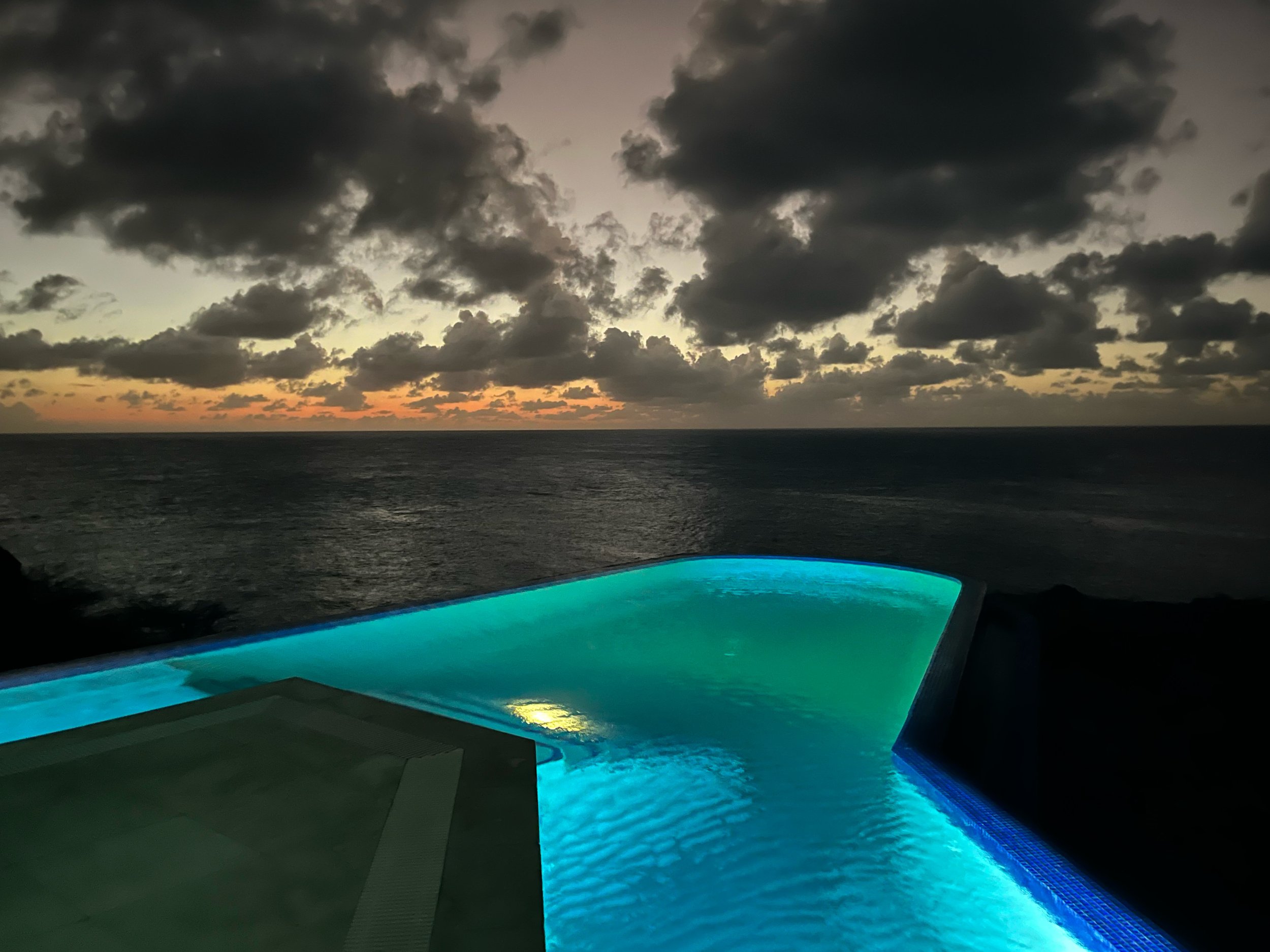
Paradise Pool & Cliff
No more Chlorine!
At Cliff Villa, your comfort and well-being are at the heart of everything we do. That’s why we’re excited to announce a luxurious upgrade to your swimming experience: our pool is now powered by magnesium.
Why Magnesium?
Magnesium pools are also known as mineral pools. The water will feel great on your eyes, skin and hair — leaving you feeling revitalized long after your swim.
1. Gentle on Eyes, Skin & Hair:
No more dryness and irritation often associated with chlorine. Magnesium’s natural properties nourish your skin and hair, leaving them feeling softer and healthier after every swim.
2. Enhanced Relaxation:
Magnesium is known for its calming effects. Swimming in our pool feels like a spa experience, helping to ease tension, improve sleep, and promote overall well-being.
3. Crystal-Clear Water:
Our magnesium pool system naturally filters impurities, ensuring crystal-clear water for your enjoyment. It’s as beautiful to look at as it is to swim in.
4. Eco-Friendly Choice:
By reducing harsh chemicals, our magnesium pool is better for the environment, reflecting our commitment to sustainability and preserving the beauty of Cliff Villa’s natural surroundings.
Laps!
An Olympic size swimming pool is 50 meters. One lap in our pool is nearly 40 meters (38.5 meters or 126 feet). 20 laps is 3/4 of a kilometre or half a mile. The pool is designed for lane swimming.
Champion swimmers never had a better view :)
You can finish with an ab workout on the deck of the pool
Spa!
Massage at the villa: Professional massage treatments can be arranged at Cliff Villa, allowing you to relax in the privacy of your room, beside the pool or outdoors with the sound of the Caribbean Sea below. Whether you are recovering from a day of swimming and exploring, easing travel fatigue or simply making time to unwind, an in-villa massage is one of the most enjoyable ways to experience the property.
Snorkelling off Cliff Villa Peninsular
The snorkeling below Cliff Villa is incredible.
Walk down the private path from the cliff and you enter a small, protected bay with coral, sea fans, tropical fish and an extraordinary amount of marine life. You do not need to swim far. Some of the best snorkeling is directly below the Villa.
The secret is to go slowly.
Put your mask on, get comfortable in the water and stop swimming for a while. Float above the reef and look carefully. Look into the rocks, under coral ledges, across the sand and just below the surface. The longer you stay in one place, the more you will see.
Start with the small fish
Sergeant majors are among the easiest fish to recognize, with their silver bodies and five black bars. You will also see brilliant blue tangs, yellowtail damselfish, French grunts, butterflyfish and several kinds of wrasse.
Look for bluehead wrasse. The adult males have an electric-blue head that is impossible to miss once you know what you are looking for.
Parrotfish are another favourite. Watch them closely and you will see them scraping algae from the reef with their beak-like mouths. If you listen underwater, you can sometimes actually hear them eating.
Hidden Fish …
Peacock flounders can almost disappear against the bottom. Their colour and markings change to match the sand and rock beneath them. Spotted trunkfish look like little swimming boxes. Sharpnose puffers are tiny and easy to overlook.
Needlefish are usually right below the surface. They are long, extremely thin and silver, so looking straight down makes them almost invisible. Look horizontally across the surface and suddenly you will see them.
Big stuff
This is when snorkeling at Cliff Villa gets really interesting.
Barracuda occasionally cruise through the bay. They can simply hang motionless in the water, watching everything around them. They look intimidating, but generally have no interest in you. Give them space and enjoy the encounter.
Tarpon are large, beautiful silver fish and unmistakable when they appear. You may also be lucky enough to see a southern stingray moving across the sand or a spotted eagle ray gliding through the bay.
Look into the holes and crevices in the reef and you may find a green moray eel with just its head visible. You may see it repeatedly opening and closing its mouth. It looks threatening, but this movement helps the eel move water across its gills.
Caribbean reef squid are wonderful to watch. Rather than simply swimming away, they can hover in the water and change colour and pattern incredibly quickly.
And occasionally there are nurse sharks. Don't panic. Don't follow them. Just give them room and watch. Seeing one in its natural environment is a great snorkeling experience.
The coral is as interesting as the fish
Don't just look for things that move.
The bay contains sea fans, sea rods, brain coral and branching corals. Look closely and you begin to understand that the reef itself is alive.
One of my favourites is the Christmas tree worm. Look for tiny red, blue, orange or white spirals sticking out of the coral. Move your hand gently through the water nearby without touching anything and they can disappear instantly into their tubes.
Sea urchins are usually tucked into holes and crevices. They are an important part of the reef because they graze on algae that would otherwise compete with coral. They are endangered in the Caribbean so no eating please.
You will also see underwater grasses and algae, including turtle grass, manatee grass, Mermaid's fan, sea lettuce and Halimeda. Halimeda is particularly interesting because it contains calcium carbonate. When it dies and breaks apart, its fragments eventually become part of the beautiful white Caribbean sand.
Anything that can hurt you?
Almost nothing in the bay wants anything to do with you. Problems generally happen when people touch something, stand on the reef, put their hands into holes or bother an animal.
Fire coral is probably the thing a snorkeler should be most careful about. It can give you a painful burning sting. Don't touch it.
Sea urchins have extremely sharp spines. Never stand on the reef and don't put your hands into crevices.
Stingrays are peaceful animals, but they have a defensive spine on their tail. Never step on, chase or corner one. Give it room.
Moray eels have powerful jaws. They are not hunting snorkelers, but never put your hand into a hole in the reef and never try to feed or touch one.
Barracuda deserve respect. Don't feed them or chase them. If you see one, simply keep your distance and watch.
Nurse sharks are generally calm around people, but they are still wild sharks. Never touch, feed, chase or corner one.
Porcupinefish and puffers are not dangerous to watch. Don't touch them and never try to make one inflate.
Needlefish are not normally aggressive, but they are fast fish with very pointed jaws. Leave them alone, particularly when they are close to the surface.
The most important rule is simple: Look at everything. Touch nothing.
A few Cliff Villa snorkeling rules
Always snorkel with someone else. Never snorkel alone.
Stay inside the bay. Do not swim out into the open ocean. There can be a strong undercurrent beyond the protected area.
Never jump from the top of the cliff.
Do not stand on the coral, break coral or remove shells, fish, coral or anything else from the water.
And don't rush. You can snorkel the same small area every day for a week and see something different every time. That is part of what makes the bay below Cliff Villa so incredible.