
Mikvé Israel-Emanuel Synagogue
The oldest continuously functioning Jewish house of worship in the Western Hemisphere — Hanchi Snoa 29, Willemstad, Curaçao.


Mikvé Israel-Emanuel Synagogue is the oldest continuously functioning Jewish house of worship in the Western Hemisphere, dating back to 1732.
The History & Lesser-Known Stories
The roots of Curaçao's Jewish community trace back to Samuel Cohen, who arrived in 1634 as an interpreter for Johan van Walbeeck during the Dutch conquest of the island. In 1651, a group of 10 to 12 families from Amsterdam's Sephardic Portuguese community, led by Joao d'Ylan, settled on the island as agricultural pioneers. These settlers were descendants of Spanish and Portuguese Jews who had fled the Inquisition, seeking refuge in the Netherlands.
By 1654, these families had established Congregation Mikvé Israel. They brought with them a Torah scroll, a gift from the Amsterdam Jewish community, which remains in use today — an extraordinary testament to the continuity of their traditions.
As Curaçao became a critical hub of trade between Northern Europe and South America, its Jewish population flourished, reaching about 1,500 by the mid-1700s. The Jews of Curaçao played pivotal roles in commerce, shipping, and even the expansion of Jewish communities across the Americas, including influential migrations to Suriname, the United States, and the Caribbean.
The Synagogue Building
The current synagogue, inaugurated in 1732, replaced earlier structures built to accommodate the growing congregation. Modeled after the Portuguese Synagogue in Amsterdam (constructed in 1675), it reflects the grandeur and architectural elegance of the Sephardic tradition.
Imported Materials
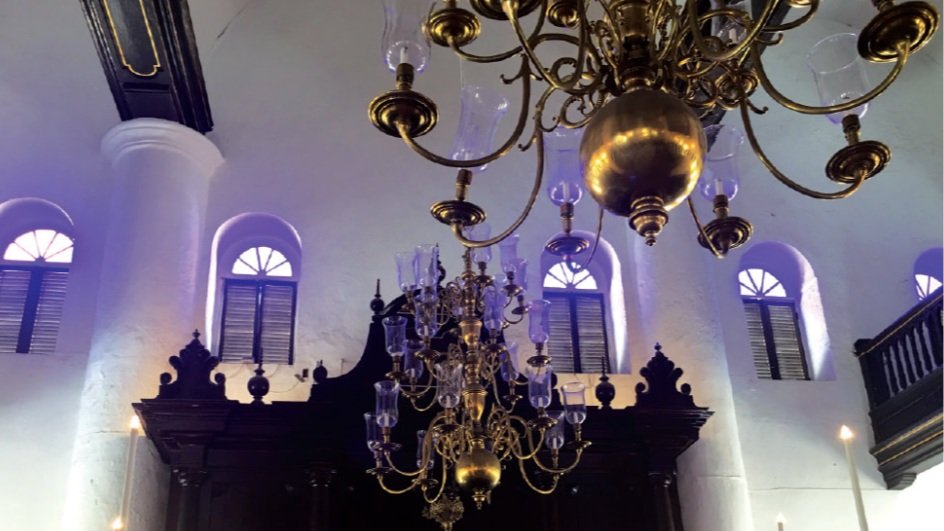
The synagogue was built with materials brought over by ship from the Netherlands, including mahogany wood for the ark, benches, and bimah, as well as the stunning copper chandeliers. One chandelier, believed to have come from the previous building, hangs closest to the ark and retains a unique historical charm.
Sand-Covered Floors
One of the synagogue's most intriguing features is its sand-covered floor. While its exact origins remain debated, two prevailing interpretations lend it symbolic weight:
- The sand represents the 40 years the Israelites spent wandering in the desert during the Exodus.
- It commemorates the clandestine worship practices of Jews during the Inquisition, who used sand to muffle the sounds of their prayers in secret.
The synagogue street's name combines Hanchi — the local Creole word for alley — and Snoa, an abbreviation of Esnoga, the traditional Judaeo-Spanish (Sephardic) word for synagogue.
Mahogany and Azure
The synagogue's dark mahogany wood contrasts beautifully with its azure stained-glass windows, which bathe the interior in soft blue light. This harmonious blend of materials and colors evokes both reverence and tranquility.
Rituals
The synagogue follows the Sephardic tradition, blending Portuguese and Hebrew in its liturgy. Each Torah service begins with a blessing in Portuguese for the Royal House of Orange, a tradition that acknowledges the protection granted to Jewish settlers by the Dutch monarchy.
The governance of the synagogue in its early years extended beyond religious matters. Board members, seated in a raised section under the clock, mediated disputes and served as de facto judges in civil matters. Their elevated position, near the synagogue's windows, also gave them access to the coolest spot in the building — a subtle nod to their authority.

The Schism of 1863
The mid-19th century brought challenges to the synagogue as the Reform movement, originating in Germany, began influencing Jewish communities worldwide. Younger members of Mikvé Israel, inspired by modernist ideas, sought changes to traditional practices. However, the Orthodox leadership resisted, leading to a schism in 1863.
The dissenting group formed Temple Emanuel, a Reform congregation that introduced innovations such as an organ in their services. To keep pace, Mikvé Israel also installed an organ — the same one still in use today. Crafted in Holland, it is one of the oldest functioning pipe organs in the world.
The two congregations coexisted separately until 1963, when dwindling membership prompted reunification, exactly 100 years after their division. Today, while Mikvé Israel retains its Sephardic heritage, about 30% of its members are Ashkenazi.
The Museum
The synagogue complex includes the Jewish Historical Cultural Museum, which houses an impressive collection of religious and cultural artifacts. Among its treasures is a silver Chanukiah that has been lit annually for over 300 years, as well as centuries-old marriage contracts, prayer books, and ritual items.
Anecdotes & Lesser-Known Stories
- Breaking the glass: Instead of crushing the glass on the sand floor, the groom smashes it on a silver tray at wedding ceremonies — which is well dented by now.
- Portuguese in prayer: The use of Portuguese in liturgy dates to the 17th century, when Sephardic Jews fleeing the Inquisition brought their Iberian language and customs to the New World.
- The Congregation's Role in the Diaspora: Curaçao's Jews helped establish the Touro Synagogue in Newport, Rhode Island — the oldest synagogue in the United States.
- The Role of Women: Jewish women in Curaçao managed family businesses and led philanthropic endeavors. Ribca Da Costa Gomez is remembered for significant contributions to education and welfare.
- A Beacon During the Holocaust: During World War II, Curaçao's Jewish community provided refuge for European Jews fleeing Nazi persecution. The synagogue became a rallying point for charitable efforts.
- Jewish Pirates: The story of Jewish pirates in the Caribbean is a fascinating chapter of resilience and revenge — figures like Moses Cohen Henriques and Samuel Pallache turned piracy into an act of survival and defiance.
Visiting Today
Mikvé Israel-Emanuel remains an active synagogue, welcoming worshippers for Shabbat services on Fridays and Saturdays. Tourists can explore the synagogue and museum from Tuesday to Friday, with an admission fee of $10. Walking through its sand-covered floors, surrounded by centuries-old artifacts, is both a spiritual and historical journey.

Notable Landmarks
Hunt's Bay Cemetery, Jamaica
One of the oldest Jewish burial grounds in the Americas. The gravestones, etched with Hebrew and Ladino inscriptions, offer a glimpse into the lives of early settlers.
Mikvé Israel-Emanuel Synagogue
Known locally as the Snoa. Built in 1732, it boasts striking chandeliers, mahogany furnishings, and a sand-covered floor. Part of the UNESCO World Heritage Site of Willemstad.
Jewish Historical Museum, Curaçao
Adjacent to the synagogue. Visitors can explore Torah scrolls, silver ritual objects, and family documents dating back to the 17th century.
Jewish Pirate Haven, Brazil
An island rumored to have been the hideout of Moses Cohen Henriques, the legendary Jewish pirate. A romantic symbol of Sephardic defiance against Spain and Portugal's oppression.
Preservation Efforts
The Jewish communities of the Caribbean are now much smaller than in their heyday. Emigration to the United States, Israel, and other regions has reduced their numbers, leaving cultural landmarks that risk being forgotten.
Organizations Leading the Effort
American Sephardi Federation
Works globally to preserve Sephardic heritage. Supports restoration projects and archives of Mikvé Israel-Emanuel.
sephardi.org →Caribbean Volunteer Expeditions
Engages volunteers in preserving Caribbean heritage, including documenting gravestones in Jamaica and Curaçao.
caribbeanvolunteers.org →UNESCO
Curaçao's Willemstad designation as a World Heritage Site includes protections for the synagogue and surrounding Jewish sites.
unesco.org →Jewish Historical Museum, Curaçao
Collects, preserves, and displays artifacts of Jewish life in the Caribbean. Actively engages with tourists and scholars.
snoa.com →Recommended Reading
- "Jewish Pirates of the Caribbean" by Edward Kritzler — Explores the role of Sephardic Jews in piracy, trade, and resistance to Spanish rule.
- "The Jewish Nation of the Caribbean" by Mordechai Arbell — A comprehensive overview of Jewish communities across the Caribbean.
- "Sephardi Lives: A Documentary History, 1700–1950" by Julia Phillips Cohen and Sarah Abrevaya Stein — Primary sources on the global Sephardic experience.
- "Remnant Stones: The Jewish Cemeteries of Suriname" by Rachel Frankel and Adam V. Wilner — Explores Jewish burial traditions across the Caribbean.
Continue Exploring